By Dr. Vanity Barr-Little
As a business owner, I am exposed to questions all day long, from employees, customers, vendors, advisors, and the market itself. Questions about growth, hiring, expansion, pricing, systems, profitability, and strategy.
The interesting thing is that I am not actively searching for most of these questions.
I simply notice them.
Over the years, I have come to recognize that one of my natural tendencies is to become aware of things that could be improved, changed, solved, or explored. I notice inefficiencies. I notice gaps. I notice opportunities and problems and possibilities.
The awareness itself is not difficult.
The challenge has been learning what to do with it.
One of the most important distinctions I have learned through my experiment is the difference between awareness and responsibility.
For a long time, I did not consciously separate the two. If I noticed a problem, I gave it attention. If I noticed an opportunity, I considered it. If I noticed something that could be improved, it occupied space in my thinking.
I was treating awareness as though it automatically created responsibility.
But not everything we notice is ours to solve. Not every opportunity is ours to pursue. Not every question requires an answer.
This seems obvious when stated plainly. I have found it much harder to practice than to understand.
In one of my existing businesses, I identified what appeared to be a natural extension of it.
The adjacent opportunity was logical. The market alignment was there. Anyone analyzing it from the outside would have called it an obvious next move.
I noticed it.
And then I did what my design requires. I waited.
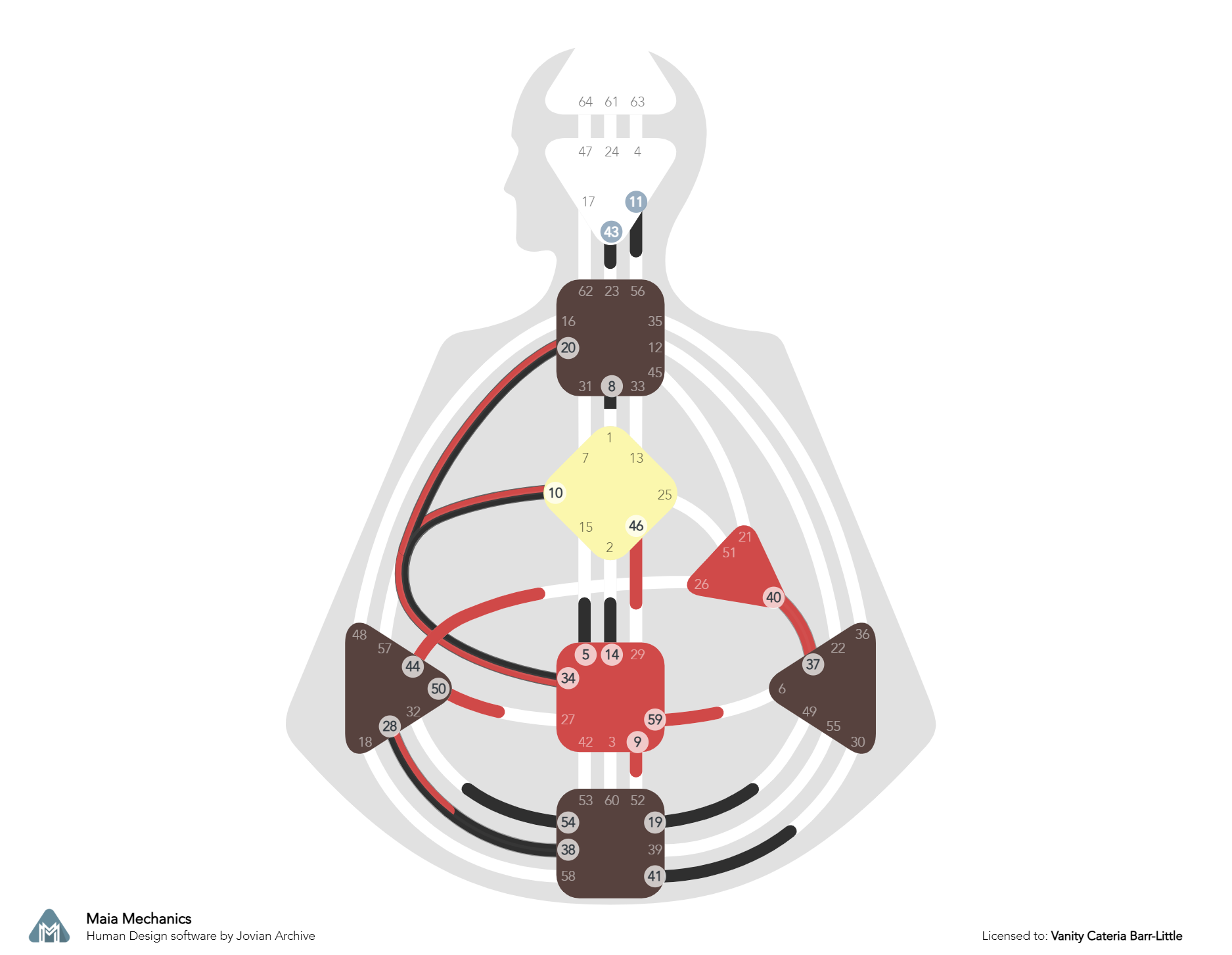
As an Express Builder with Emotional Authority, my decision-making is not immediate. It does not come from a gut response in the moment. It comes from riding the emotional wave over time and waiting for clarity to emerge. Not certainty, clarity. The difference matters. Certainty rarely comes. Clarity does, when I stop forcing a decision and allow the wave to move through.
At the peak of noticing this opportunity, it felt compelling. That is how it works with Emotional Authority. Things can feel very right at the high of the wave and very wrong at the low. Neither state is the truth. The truth is what remains when the wave settles.
When I gave it time and checked back in across different emotional states, the clarity I arrived at was no.
Not because the logic had changed. The logic was still intact. The market was still there. The alignment on paper had not moved.
But in BG5, logic is not the decision-making mechanism. For an Express Builder with Emotional Authority, the mechanism is waiting for emotional clarity, and when that clarity arrived, it said no.
That was enough.
One of the reasons this became so apparent to me is because business creates an endless supply of questions. There is always another idea, another possibility, another system to build, another problem to solve.
The supply is infinite.
For an Express Builder, opportunity recognition is natural. The open Head Center creates pressure to engage with every opportunity that enters your awareness.
Seeing an opportunity and pursuing an opportunity are two very different things. The first happens naturally. The second requires resources.
When I think about mental pressure, I do not think about stress in the traditional sense.
I think about attention.
Every question occupies space. Every unresolved issue occupies space. Every possibility occupies space. Individually, none of them may seem significant. Collectively, they can become surprisingly expensive, mentally and financially.
The cost appears as distraction, as energy and resources directed toward things that were never actually yours to pursue.
One of the greatest challenges is not deciding what to pursue. It is deciding what does not deserve pursuit.
This is where BG5 has been the most practically useful for me as a business owner.
The mind is extraordinarily good at noticing things. It is not designed to decide what to do with them.
In BG5, decisions are not made by the mind, regardless of how logical, aligned, or compelling something appears mentally. The mind's role is to observe and inform. It is not the authority.
Every person has a specific decision-making Strategy and Authority built into their design. That is the reliable mechanism. That is what determines what is actually correct for you to pursue, not analysis, not opportunity mapping, not logic.
For a long time, I did not fully separate those two things. I would notice an opportunity and immediately begin thinking about it, evaluating it, building it out mentally, assessing fit. The noticing and the deciding had collapsed into the same motion.
What Emotional Authority requires is time. Not deliberation, time. There is a difference. Deliberation is the mind working harder. Waiting for emotional clarity is the body and the wave doing what they are designed to do.
When I stopped trying to resolve questions mentally and started allowing the wave to move through, the pressure shifted. Not because fewer questions arrived. They did not. But the mind no longer had to resolve them on the spot.
It just had to notice them.
Strategy and Authority handles the rest, on its own timeline.
I no longer feel the same urgency to engage with every question that enters my awareness.
A question can exist without requiring action. A problem can exist without requiring my involvement. An opportunity can exist without requiring pursuit.
I have become more comfortable allowing questions to remain unanswered, allowing possibilities to remain unexplored, and recognizing that awareness alone does not determine relevance.
Sometimes a question deserves immediate action. Sometimes it deserves observation. Sometimes it deserves nothing at all.
If there is one lesson my experiment has taught me, it is that in business particularly, awareness creates no obligation.
I can notice something without owning it. I can recognize a possibility without pursuing it. I can become aware of a question without feeling responsible for answering it.
For me, this has been one of the most practical applications of BG5 in business, not because the questions have disappeared, but because my relationship with them has changed.
I no longer assume that everything I notice deserves my attention.
And in many ways, that shift has been far more valuable than finding the answers themselves.
As business owners, we are surrounded by questions. Some are important. Some are not. Some require action. Some do not.
The challenge of an open Head Center has never been a lack of answers.
It has been learning to distinguish between what I am aware of and what is mine to engage with.
The questions will always be there. The pressure may always be there.
For those of us with an open Head Center, the wisdom comes from understanding that not everything that enters our awareness belongs in our focus, and that the most reliable way to know the difference has nothing to do with the mind at all.

Dr. Vanity Barr-Little is a BG5 consultant, decorated Air Force veteran, wife, mother of four boys, and the founder and CEO of VANBAR Holdings, a diverse portfolio of award-winning small businesses based in Tampa, Florida.
Her military service earned her two Air Force Achievement Medals with four oak leaf clusters, two Air Force Commendation Medals, the Iraqi Campaign Medal with a bronze star, the Air Force Outstanding Unit Award, the AF Longevity Service Medal, and the Korean Defense Service Medal.
In her civilian career, Dr. Barr-Little has been recognized as a 2024 Enterprising Women of the Year Award winner, a global honor for successful women entrepreneurs. She has been featured in Enterprising Women Magazine, the Tampa Bay Business Journal, and KNOW Tampa.
As a BG5 consultant, her work centers on helping individuals understand their unique career and business designs and apply that understanding to how they operate and make decisions that are correct for them.